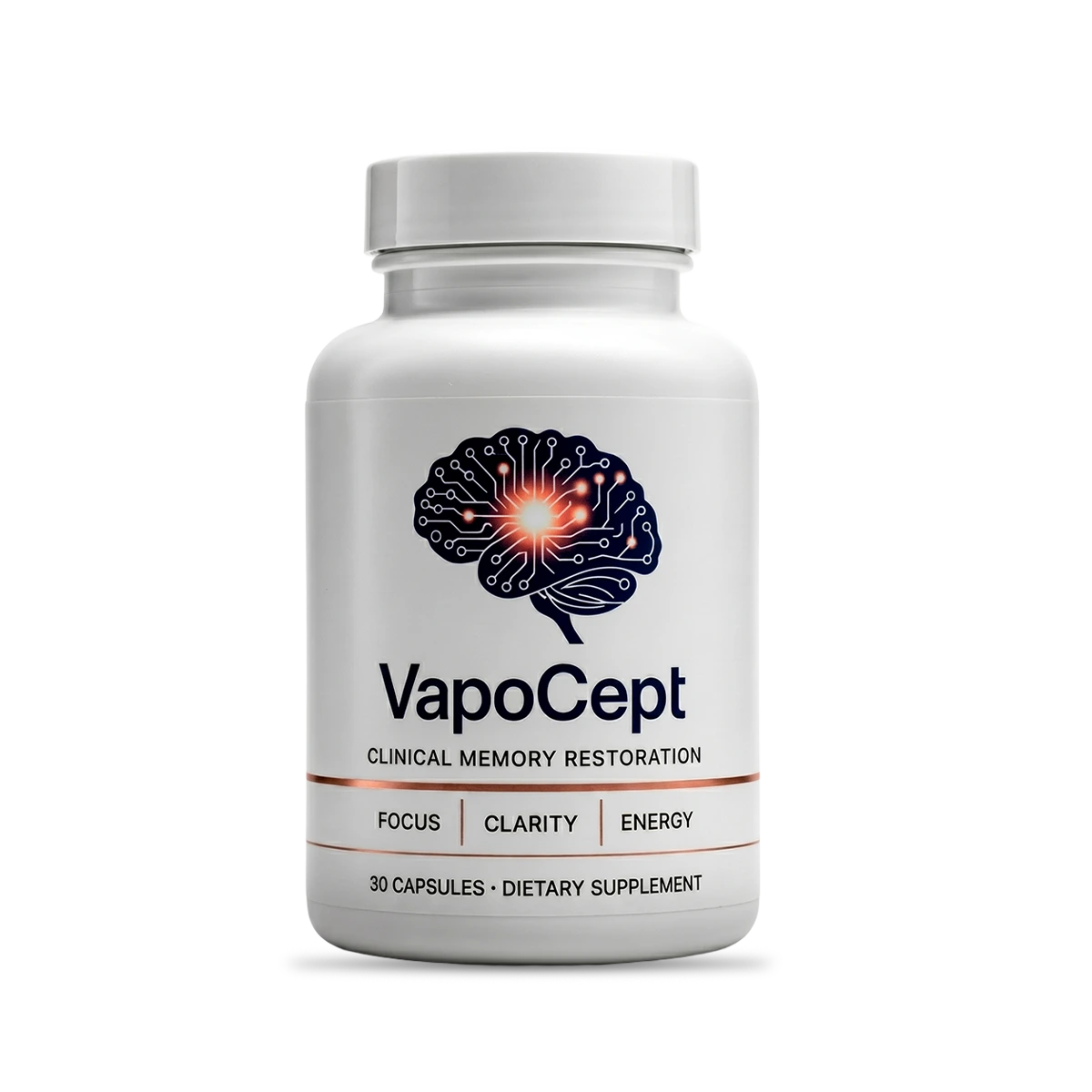
The full VapoCept ingredient list and VapoCept ingredients and benefits, set out one extract at a time: six actives, three inactive ingredients, no proprietary blend. This is a six-ingredient brain supplement in which every active is printed separately on the panel, so you can look each one up before you buy.
People arrive at this page looking for different things — brain health ingredients, natural ingredients for brain health, or simply the nutrients for brain health that a given product contains. Products in this space are variously described as a brain support supplement, a brain wellness supplement, a brain health formula, a botanical brain supplement, a herbal brain supplement or a plant-based brain health supplement. All six actives here are plant or nutrient extracts, so most of those labels apply.
Below, each extract has its own section — what it is, why it earns a place in this natural memory and focus formula, what the research shows, and short answers to the questions people most often search for.
1. Ginkgo Biloba Extract
A Ginkgo Biloba supplement is the most familiar item in this category, and Ginkgo Biloba extract is the most-studied botanical in memory research by a wide margin. The leaf extract is standardised for flavonoid glycosides and terpene lactones, and comes from a tree species essentially unchanged for over two hundred million years.
Why it's here: Ginkgo Biloba circulation support is the long-standing rationale. Brain tissue consumes roughly a fifth of the oxygen you breathe despite being about two percent of body weight, and how readily small vessels widen on demand tends to decline with age.
What the research shows: extensive and genuinely mixed. Several controlled trials report modest gains in attention and recall speed in healthy older adults. The large Ginkgo Evaluation of Memory study found it did not reduce dementia incidence over several years. Both findings are real and both belong on this page.
Quick answers
- Is Ginkgo Biloba for memory support well evidenced? Partially. Short-term everyday-cognition findings are modest and inconsistent; it is not a preventive treatment.
- What about Ginkgo Biloba for brain health generally? It is used as a Ginkgo Biloba brain supplement for circulatory support rather than for any single outcome.
- Ginkgo Biloba for mental alertness or Ginkgo Biloba for focus? Some attention findings exist, but green tea's caffeine-theanine pairing has the clearer short-term data.
- Choosing the best Ginkgo Biloba supplement: look for a stated standardisation, not just a milligram figure, and check it isn't inside a blend.
- Ginkgo Biloba supplement for seniors: the interaction with blood thinners matters more with age, because medication lists are longer. Speak to a prescriber first.
Caution: affects bleeding time. Check with your doctor if you take anticoagulant or antiplatelet medication; typically stopped before scheduled surgery.
2. Marigold Extract (Lutein and Zeaxanthin)
A marigold extract supplement is the standard commercial source of lutein — most marigold lutein supplement products exist because marigold petals concentrate these carotenoids better than almost anything else grown at scale.
Why it's here: most people know lutein from eye health, but the case for marigold extract for brain health is that lutein crosses into neural tissue and concentrates there rather than passing through. Autopsy work has confirmed it makes up a disproportionately large share of brain carotenoid content.
What the research shows: the most coherent case in the formula. Lutein status in older adults tracks consistently with memory and processing-speed performance, and a randomised trial of 12 mg daily lutein and zeaxanthin reported improvements in complex attention and cognitive flexibility.
Quick answers
- Lutein for memory support — is that established? The association is consistent; much of the data is observational, so causation is not settled.
- Lutein for cognitive health versus eye health: the same compound, two tissues. The cognitive research is newer and smaller.
- Is this a lutein antioxidant supplement? Lutein is a fat-soluble antioxidant, which is why marigold extract cognitive support is usually discussed alongside oxidative load.
- Lutein and brain aging: accumulation takes months, which is the clearest argument for consistent daily intake rather than occasional use.
- Is a lutein brain health supplement worth taking with food? Yes — absorption improves substantially with dietary fat.
3. Turmeric Extract
Turmeric root extract supplies curcuminoids, among the best-characterised plant antioxidants. A turmeric brain health supplement and a curcumin brain health supplement are usually the same thing described two ways — curcumin is the most abundant curcuminoid.
Why it's here: turmeric antioxidant supplement ingredients act on oxidative stress and inflammatory signalling, two processes involved in how the brain ages. That is the basis for turmeric cognitive support and for antioxidant support for brain health more broadly.
What the research shows: outstanding in the laboratory, modest in humans, and the gap is almost entirely absorption. An 18-month randomised trial using a bioavailability-enhanced form reported memory and attention improvements in adults without dementia — encouraging, in a small group.
Quick answers
- Turmeric for memory support — does it work? The human evidence is preliminary. Treat it as promising rather than settled.
- Turmeric for cognitive health versus a turmeric supplement for brain health: no meaningful difference; what matters is curcuminoid content and absorption.
- Curcumin for cognitive support — what limits it? Poor oral absorption and rapid clearance. Take it with a meal containing fat.
Caution: can cause mild stomach upset without food; stimulates bile flow, which matters with gallbladder disease.
4. Green Tea Extract
A green tea extract supplement concentrates catechins — principally EGCG — along with the caffeine and L-theanine naturally paired in the leaf.
Why it's here: green tea antioxidants for brain health contribute water-soluble antioxidant activity that complements the fat-soluble compounds elsewhere in the formula. Separately, the caffeine-and-theanine pairing has been studied for attention, which is the basis for green tea extract for mental alertness and green tea extract for focus.
What the research shows: reasonably consistent short-term attention data. A randomised study of L-theanine with caffeine found improved attention accuracy, faster reaction time and reduced self-reported mental fatigue — effects that differed from caffeine alone. Long-term cognitive-aging data is thin.
Quick answers
- Green tea extract for brain health — how strong is the case? Good short-term attention findings, limited long-term outcome trials.
- Is EGCG cognitive support the main mechanism? An EGCG brain health supplement is usually sold on antioxidant grounds; the attention findings are attributed more to caffeine plus theanine.
- Green tea extract cognitive support and caffeine sensitivity: the amount here is well below a cup of coffee, but morning dosing is sensible.
- A green tea and Ginkgo Biloba supplement — why combine them? Different mechanisms: attention support alongside circulatory support.
5. Bamboo Extract
A bamboo extract supplement is the richest plant source of bioavailable silica, which is why bamboo silica supplement products exist in the first place, with flavonoid antioxidants alongside.
Why it's here: silica contributes to connective tissue integrity, which includes the structural components of blood vessel walls. That is the basis for describing it as a silica supplement for healthy aging, and the flavonoid fraction adds bamboo extract antioxidant support from a different chemical family than the other ingredients.
What the research shows: minimal where cognition is concerned. Bamboo extract health benefits are documented for connective tissue and antioxidant activity; there is no substantial body of human research linking it to memory or focus. It is a supporting ingredient, and saying otherwise would require inventing a story the evidence does not support.
6. D-Glucosamine Sulfate Potassium Chloride
A D-Glucosamine Sulfate supplement is best known from joint formulas. The amino sugar is synthesised naturally by the body and supplied here as the sulfate form stabilised with potassium chloride — the chloride is a stabiliser, not a separate active.
Why it's here: D-Glucosamine supplement benefits reported in large population datasets include lower inflammatory markers and lower cardiovascular event rates, and cardiovascular health tracks with long-term cognitive health. A glucosamine and Ginkgo Biloba supplement pairing therefore addresses vascular health from two directions.
What the research shows: indirect. A UK Biobank analysis of 466,039 participants found habitual glucosamine use associated with lower cardiovascular event rates — observational only, and it cannot establish cause. No trial has tested glucosamine for memory outcomes.
Caution: sometimes shellfish-derived — confirm the source if you have a shellfish allergy. Mention it to your doctor if you manage diabetes.
Where this sits among supplements for brain health
Anyone comparing natural supplements for brain health, or weighing vitamins and supplements for brain health against a botanical formula, is really asking which mechanism they want. A healthy brain function supplement built from extracts works gradually; a vitamin corrects a deficiency. Brain support capsules of this type are closer to the first.
Described in cognitive terms, this is a cognitive health supplement rather than a cognitive performance supplement — natural cognitive support intended as daily cognitive support, not an acute one. A cognitive health formula of this kind aims to support healthy cognitive function over months. Whether you call it cognitive support for adults, cognitive support for seniors, cognitive health for older adults or cognitive health for seniors, the intent is the same: healthy cognitive aging and cognitive aging support, not a treatment. Cognitive wellness for seniors and cognitive function support for seniors describe the same use case at a later stage of life.
How the six work together
Taken as a whole this is a multi-ingredient brain health supplement built as a botanical memory support formula rather than a single-nutrient pill. The reasoning behind a brain health antioxidant formula of this kind is that no one antioxidant is active in every tissue compartment, and no single mechanism covers everything people mean by "memory".
A Ginkgo Biloba turmeric memory supplement pairing — sold elsewhere as a Ginkgo Biloba and turmeric supplement — addresses circulation and oxidative load together, and a Ginkgo Biloba and green tea supplement pairing adds attention support to circulatory support; adding marigold, green tea and bamboo widens the antioxidant coverage; glucosamine contributes on the inflammatory and vascular side. That is the case for daily botanical brain support in natural brain health capsules rather than five separate bottles.
The honest trade-off: with six ingredients working together, you cannot attribute any improvement to one of them. You gain coverage and lose clarity. We think that is the right trade for a natural cognitive wellness formula intended for daily long-term use, but you should know you are making it.
VapoCept ingredients at a glance
Taken together these make up the VapoCept brain health formula — a VapoCept natural brain supplement and a VapoCept memory and focus supplement in one capsule.
- VapoCept D-Glucosamine — cellular and inflammatory support
- VapoCept Ginkgo Biloba — circulation support; as a Ginkgo Biloba memory supplement it is the ingredient most people recognise, and Ginkgo Biloba cognitive support is its usual framing
- VapoCept turmeric — antioxidant support
- VapoCept marigold extract — the source of VapoCept lutein, for neural tissue
- VapoCept green tea extract — attention and antioxidant support
- VapoCept bamboo extract — silica and structural support
The three inactive ingredients
Bovine gelatin capsule — the shell, and the detail most likely to rule the product out for someone. It is animal-derived, so VapoCept® is not suitable for vegetarians or vegans and is not certified halal or kosher.
Magnesium stearate — a flow agent that keeps powder moving through encapsulation machinery so fill weights stay consistent. Present in a large share of capsules at a few milligrams per dose.
Microcrystalline cellulose — purified plant fibre used as a bulking agent. Inert and plant-derived.
Why the VapoCept supplement facts panel has no proprietary blend
A proprietary blend groups several ingredients under one combined weight with no individual amounts. It is legal and extremely common, and it makes it impossible to tell whether an ingredient is present at a research-relevant amount or as a trace added so the name can appear on the front of the bottle.
Because all six of these are listed separately, you can check each against your own medication list, take the panel to a pharmacist, and compare amounts to published trials. That does not guarantee a result — it just means you are not buying blind.
See Price & Packages